Gazing into the computer (Part 1)
Nearly 50 years ago, Jean-Pierre Luminet used an IBM mainframe to calculate what a black hole would look like, then drew an image by hand. I find it immensely beautiful. Notably, he used a computer to predict something about the depths of the universe—in this case, the accretion disk of a spherical black hole.
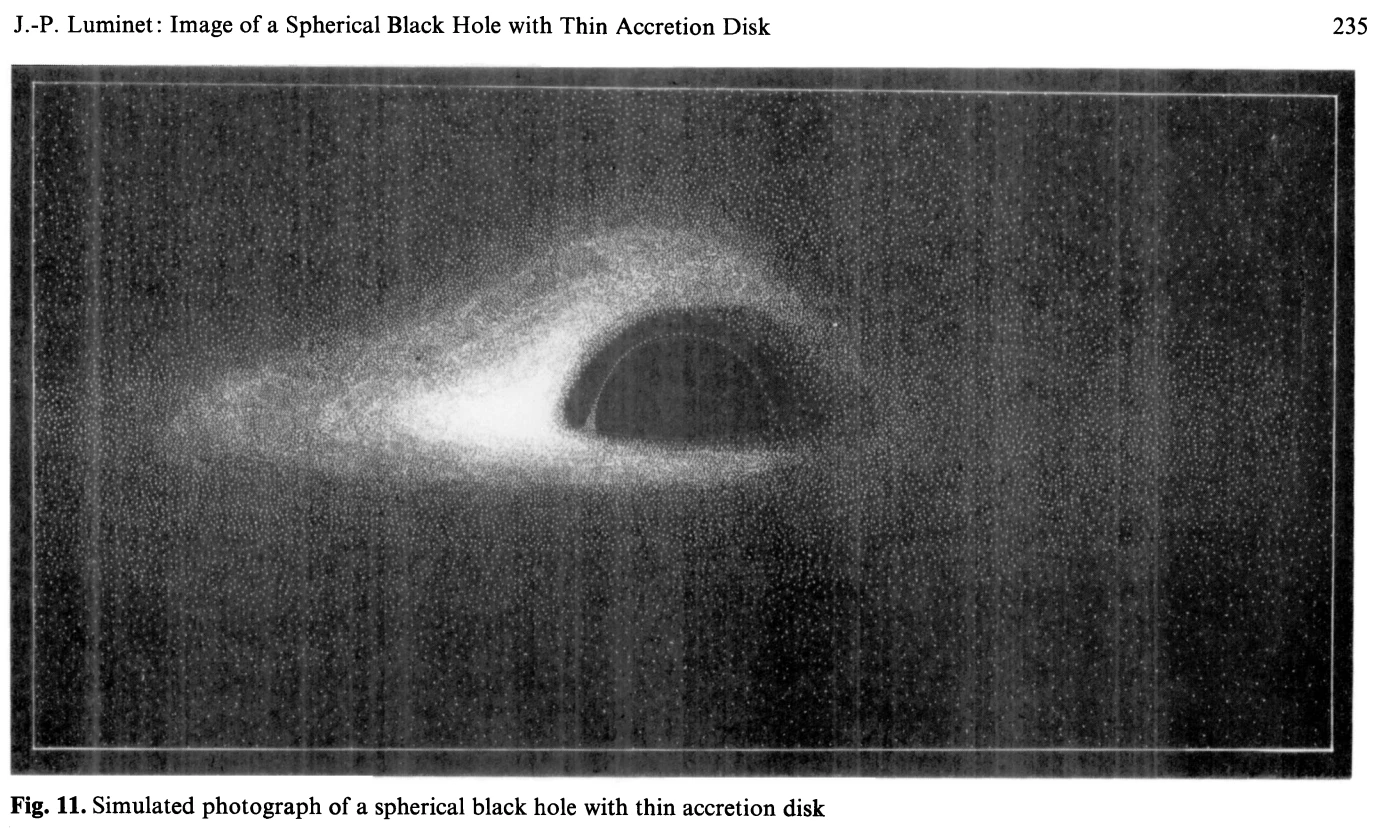
I tasked GPT-6 Astra with bringing it to life (in the browser) with modern methods. It analyzed the image pixel by pixel and recovered 18,465 points to simulate. It read Luminet’s original paper and studied a 2022 paper called Adaptive Analytical Ray Tracing of Black Hole Photon Rings to model Schwarzschild orbits, curved light paths, Doppler shifts, gravitational redshift, and light-travel delays.
Astra achieved this by writing ~14,600 lines of Python simulation code and custom Apple Metal GPU kernels to calculate the relativistic light effects as each dot orbited the black hole.